
RBT DOCUMENTATION RESOURCE
RBT Session Notes: A Clearer, Faster Documentation Workflow
A practical guide to clearer RBT session notes, including objective language, treatment-plan alignment, data context and an efficient review workflow.
Registered Behavior Technicians (RBTs) spend 2-3 hours on administrative tasks for every hour of direct client contact, much of that time completing RBT session notes. That ratio reveals something broken in how ABA therapy operates today.
The work RBTs are trained to do, implementing behavior interventions, teaching skills, reducing problem behaviors, gets squeezed into smaller windows while RBT session notes expand to fill the gaps.
This isn’t a minor inefficiency. It’s a structural problem that’s driving 96% of RBTs to experience severe burnout symptoms.

The 30-Minute RBT Session Notes Tax
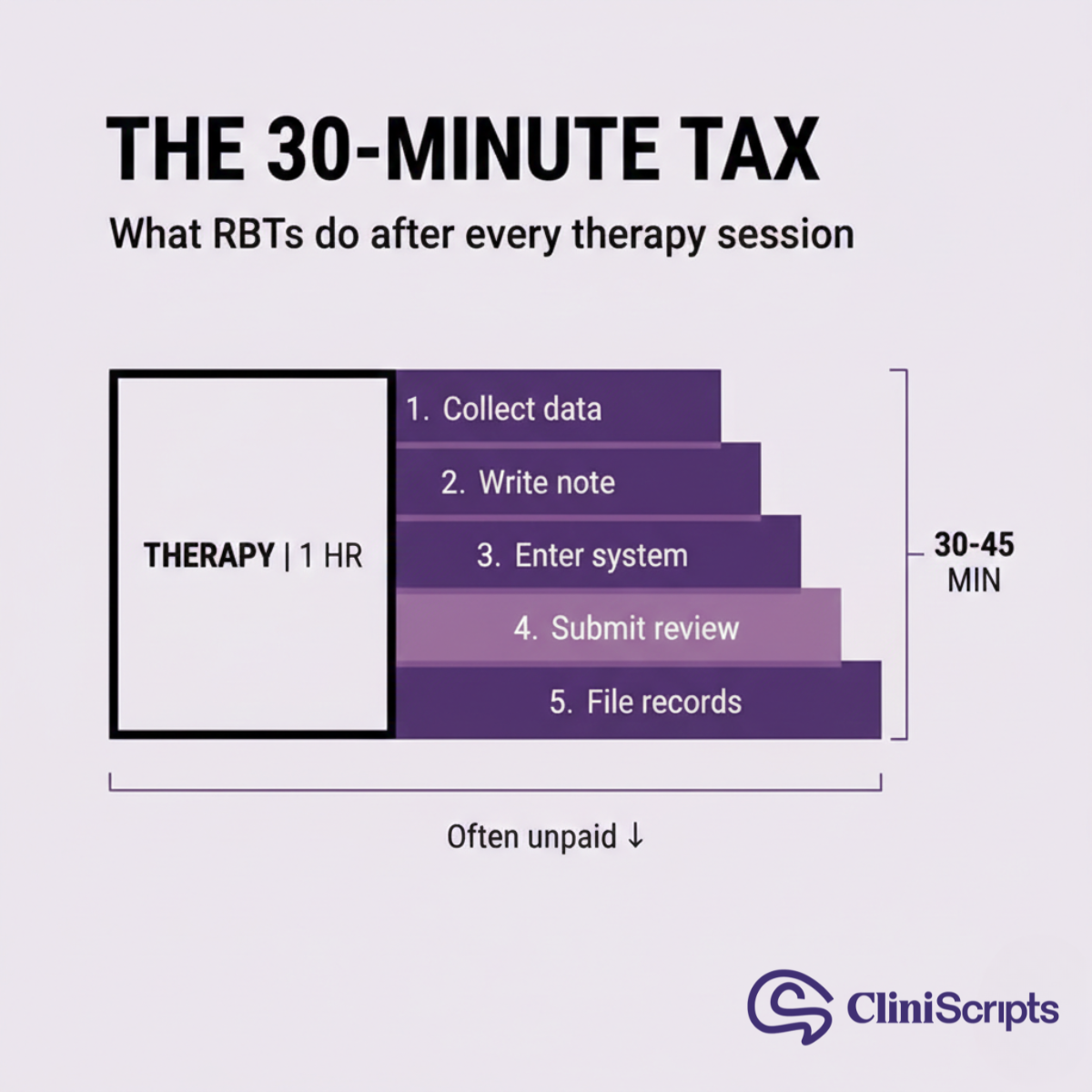
When an RBT finishes a therapy session, the clinical work is only halfway done. Here’s what happens next in the creation of RBT session notes:
- First, they collect and organize session data. During the session, they’ve tracked behaviors, prompts, reinforcements, and skill acquisition, often on paper, clipboards, or tablets. Now they review every data point for accuracy: frequency counts, duration measures, latency times, ABC logs. Juggling multiple forms and spreadsheets creates gaps. Data goes missing. Inconsistencies creep in.
- Second, they write the formal RBT session note. This includes date, time, duration, skills targeted, progress made, behaviors observed, interventions used, client response, and recommendations for the supervisor. Most clinics require structured templates, so the note must fit a specific format. This is where raw numbers transform into narrative. The RBT translates data into something clear, professional, and clinically meaningful.
- Third, they enter data into the system. Manual entry follows: session codes for billing, progress metrics for each targeted skill, behavior incident flags. Some systems require double entry, once for clinical records and once for billing. Repetitive work under deadline pressure invites human error.
- Fourth, they submit RBT session notes for supervisor approval. Most notes get reviewed by a BCBA before finalization. The back-and-forth creates delays in documentation and billing.
- Finally, they file and organize records. Notes and data get saved in the client’s chart, organized by date and session. Some clinics still maintain hybrid paper-digital systems, adding another layer of complexity.
This process consumes 30-45 minutes after a one-hour session. Multiply that across multiple sessions per day, and you see why RBT session notes can eat up 60% of an RBT’s work time.

The Economic Reality Nobody Talks About
Most RBTs get paid based on billable clinical hours, time spent directly delivering therapy to clients.
That 30-45 minute RBT session notes window? Often unpaid.
When RBTs finish their sessions and spend another half hour completing notes, that time typically falls into one of three categories:
- Unpaid work. The RBT completes RBT session notes “on their own time” without credit or pay. This is common in private clinics and home-based therapy where productivity targets run high.
- Under-compensated work. Clinicians might receive a flat hourly rate that technically includes documentation time, but the rate doesn’t reflect how much extra time it actually takes.
- Incentive pressure. RBTs face pressure to finish notes quickly to start the next session or leave for the day. This compromises note quality and accelerates burnout.
💡 Documentation time isn’t recognized as revenue. Billable hours generate clinical revenue for clinics and agencies. RBT session notes do not. Anything that reduces unpaid admin time directly improves an RBT’s income and quality of life.
High turnover follows predictably. When RBTs feel like they’re doing a full hour of clinical work plus another half hour of unpaid RBT session notes, job satisfaction drops and turnover rises.
The numbers confirm this pattern. The ABA field experiences turnover rates between 77.4%-103.3% annually, with each departing employee costing organizations an estimated $15,000-$25,000 in recruitment, training, and lost productivity.

How AI Changes the RBT Session Notes Workflow
AI documentation tools address this economic pressure directly.
Instead of manually writing, formatting, and entering RBT session notes after each session, AI can transcribe sessions, generate structured notes, populate billing codes, and format reports for supervisors.
This cuts post-session admin time from 30-45 minutes down to just a few minutes of review.
Efficiency gains are measurable. Studies show AI-supported administrative tasks can cut administrative time by 5-10 hours per week and deliver 95% clean claim accuracy. Real-time tools can reduce the RBT session notes burden by up to 50%.
When RBTs spend less time on unpaid documentation, they can stay on schedule, end their workday sooner, and focus more on client interaction, which is billable. Some can take on an extra paid session without overload.
Agencies benefit too: faster documentation turnaround, reduced billing errors, better compliance with supervision requirements, and less staff turnover.

The Accuracy Advantage of AI for RBT Session Notes
AI doesn’t just save time. It improves data quality.
Manual documentation under time pressure creates predictable problems. Data points get missed. Notes lack consistency. Behavioral tracking loses precision.
Research shows clients served by professionals experiencing high burnout showed 27% slower progress toward treatment goals. Meanwhile, consistent data collection in RBT session notes improves treatment outcomes by 23% compared to programs with inconsistent monitoring.
AI tools help standardize RBT session notes across providers. When every session note follows the same structure and captures the same data points, supervisors can spot patterns more easily. Treatment planning becomes more precise. Progress monitoring gets more reliable.
⚠️ Documentation scrutiny from insurers is increasing in 2026. Incomplete or vague RBT session notes are one of the top reasons for recoupments. Every note needs to clearly support the CPT code billed. Overbilling by even a few minutes can flag clinics for audit.
AI helps clinics meet these compliance requirements without adding to the RBT’s workload.
Addressing Skepticism About AI in RBT Session Notes
Can AI capture the nuance of a therapy session? What about HIPAA compliance? Does automation remove the human element from RBT session notes?
AI tools work as assistants, not replacements. The RBT still reviews and approves every note. The AI handles transcription and formatting. The clinician ensures accuracy and adds clinical judgment.
Security and compliance are built-in. Medical-grade AI documentation tools are designed with HIPAA compliance from the ground up. Data encryption, access controls, and audit trails are standard features.
The human element stays central. AI captures what happened in the session. The RBT interprets what it means, adds context, and makes clinical recommendations. The technology handles the administrative burden so clinicians can focus on the clinical thinking.
What This Means for ABA Practice
The shift toward AI documentation isn’t optional innovation. It’s an inevitable evolution driven by economic necessity and workforce sustainability.
AI tools like CliniScripts automate repetitive, time-consuming parts of RBT session notes while preserving clinical judgment and quality.
The result: RBTs spend more time with clients and less time on paperwork. Better data quality. Faster billing cycles. Lower turnover. More sustainable careers.
The ABA field is still structured around manual documentation systems. AI is reshaping that structure to match how therapy actually works, prioritizing direct client interaction while handling the administrative overhead that’s been weighing clinicians down for too long.
We’re seeing the beginning of that transformation now. The practices that adopt AI documentation early will have a competitive advantage in recruiting and retaining talented RBTs. The ones that wait will keep losing staff to burnout and better opportunities.
The choice is becoming clearer every day.
CONNECTED DOCUMENTATION
Bring RBT documentation into one connected ABA workflow
Support consistent data capture, note completion and supervisor review without adding another disconnected process.





 All Rights Reserved