
Quick Answer
An AI scribe for therapists records sessions automatically, allowing you to maintain full therapeutic presence without manual note-taking. You remain engaged with your client while the technology captures session content, which you refine into clinical documentation afterward. This preserves the attunement essential to therapy while eliminating the cognitive split that traditional note-taking creates.
The Real Challenge: Being Present While Documentation Looms
The thing about being a therapist is that it’s all about being present. The way you sit, the way you look at someone, the way you pick up on little things like a shaky voice when they talk about something that hurts. That’s what makes people feel better. But then there’s all the paperwork you have to do after. You’re trying to write down everything that happened in a session, remembering exactly what someone said, while also getting ready for the next person who’s waiting to see you. It’s like you’re being pulled in two different directions. You want to help people, but you also have to deal with all the administrative stuff. And it’s hard to keep track of everything when you’re going from one session to the next without a break.
This is where an AI scribe for therapists can really make a difference. It’s not that it replaces your expertise or the personal connection you have with your patients, but it helps take away the mental workload that distracts you from what really matters—the therapy itself. By handling documentation in the background, an AI scribe for therapists allows you to focus on the moment and give your undivided attention to your patients, which is essential for building trust and achieving the best possible outcomes.

Why Documentation Steals Your Presence
When you’re taking notes by hand during a session, it’s like your brain is divided into two parts. One part is focused on what your client is saying, while the other part is busy thinking of how to put it all into neat sentences for their file. As a result, you might miss some of the tiny facial expressions that can be really important. You also have to stop the conversation to write something down, which can be distracting. And your client can tell when you’re not fully present with them – it’s like they can feel it. You’re not completely there, and that can make a big difference in how they open up to you. It’s like you’re only half listening, and that’s not what they need from you.
The facts support this idea. Therapists who have a hard time with paperwork and other administrative tasks tend to be less happy with their jobs and, more importantly, are not as good at helping their patients. Your attention is limited, and every moment you spend writing the perfect notes for a patient’s mental health record is a moment you’re not completely focused on them. This can really affect the quality of care you provide, because when you’re distracted by paperwork, you can’t give your patients the full attention they need.

How an AI Scribe Protects Your Therapeutic Presence
You Stay in the Room
When you’re with a client, an AI note taker takes care of the session for you. This means you can focus completely on the person in front of you. It doesn’t matter if you’re using a free AI note taker or one that’s really advanced – they both work in the same way. The technology does the job of writing down what’s being said, so you can keep your hands, eyes, and attention on your client. This way, you can give them your full attention, without getting distracted by taking notes.
I’ve found that placing the recording device in a neutral spot and casually mentioning it can be really effective. Most people appreciate the honesty and actually feel more at ease, because it shows you’re not busy scribbling notes, and that you’re fully focused on them. This way, they know they have your complete attention.
Notes Are Generated, Not Remembered
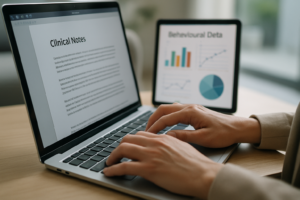
When the session is over, your clinical note-taking AI has already got everything written down. You don’t have to try to remember what happened when your memory is fading. Instead, you can work from a complete transcript of the session. This means you can quickly look over and edit a pre-filled SOAP note for psychotherapy, rather than having to start from scratch and write the whole thing yourself.
This isn’t just about being faster, it’s also more accurate from a clinical standpoint. You’re not having to rely on bits and pieces of information that you remember, or just recalling certain parts of what was said. Instead, you have the exact words your client used, the order in which they expressed their thoughts, and the precise moment when something important happened.
The Edit, Don’t Create, Workflow
What’s great is that most clinicians are using their time to make notes more personal and detailed, rather than having to create them from scratch. This is a different kind of thinking – one that doesn’t need you to be fully focused on the patient at that moment. It’s more about refining what’s already there, which can be done at any time.
You review what the AI captured, add your clinical observations, adjust the tone to match your style, and ensure it reflects your treatment conceptualization. This happens after the session, during admin time, when your full presence isn’t therapeutically needed.

Practical Steps to Maintain Presence While Using an AI Scribe
Get everything ready before your session begins. Take a few minutes to check that your recording device is working properly, your mic is in the right spot, and you have all the necessary app permissions. Do this about 5 minutes before your first client arrives. You want to make sure everything is running smoothly so you can focus on building a connection with your client from the very start. Technical issues can be frustrating and might make things a bit awkward when you’re first getting to know each other.
Let’s be open with our clients about the technology we’re using. A straightforward explanation can go a long way – just say something like, “I’m going to record our session so I can give you my full attention, instead of taking notes.” Most of the time, clients appreciate this approach because it shows we’re putting their needs first. By being honest and transparent, we can build trust and make them feel more at ease. It’s all about making the experience as comfortable and beneficial for them as possible.
Put the recorder in a spot where it’s not too noticeable. You can place it on the side of your desk, at an angle, so it’s not right in people’s line of sight. This way, you’re being upfront about it being there, but you’re not making a big deal out of it either. It’s kind of like finding a balance between being honest and not being too intrusive.
Resist the urge to check the transcription during session. Just because AI doctors notes are being generated doesn’t mean you should peek at them. Trust the technology. Stay in the room.
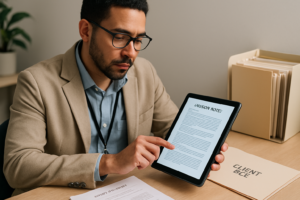
Review and customize after the session. Spend 10-15 minutes reviewing the AI-generated draft, adding clinical observations, adjusting language, and ensuring the note reflects your clinical formulation. This is when technology serves you.
To make the most out of AI scribes, it’s a good idea to use a template for your ABA session notes, like the one your clinic usually uses. This helps the AI understand how you like your notes set up. You can even set up your system to automatically fill in your favorite template, making things easier for you.

What Gets Lost (And What Doesn’t)
Let’s be honest: AI transcription isn’t perfect. It’ll misidentify terms sometimes. It won’t capture meaningful silence. It can’t quantify the emotional weight of what was said—just the words themselves.
That’s exactly why your clinical expertise remains essential. You’re not replacing your judgment with AI; you’re automating the clerical work so your judgment has more room to breathe. The AI gives you an AI generated doctors note framework. You provide the clinical interpretation, the treatment planning, the nuance.
The research on clinical note-taking is clear: brief, accurate documentation done soon after session is gold standard. An AI scribe for therapists gets you there faster, which paradoxically means your notes are more clinically sound because you’re not exhausted and time-pressured when you finalize them.
Making It Work in Your Actual Practice
When you first start using the AI scribe method, begin with just a few sessions to see how it goes. Pay attention to how your focus changes. A lot of therapists have said that within a week, they’re picking up on things they used to overlook – like a client’s metaphor that says a lot about how they see themselves, or a slight pause before they talk about something specific. This can be really helpful in understanding your clients better.
Technology doesn’t make your therapeutic presence any less powerful, it actually sets it free.

Frequently Asked Questions
Will clients feel uncomfortable with an AI scribe recording them?
Most clients respond positively when you frame it transparently: “I’m recording so I can give you my full attention rather than taking notes.” Position the device visibly but unobtrusively, and it quickly becomes background.
How accurate are AI note takers for clinical documentation?
Clinical-grade AI note takers achieve 95%+ accuracy for clinical terms when trained on mental health language. You still review and edit for clinical formulation, making the final note entirely your professional work.
Can I use a free AI note taker for therapy notes?
Free options work for basic transcription, but they often lack mental health-specific training and may not integrate with HIPAA-compliant systems. For clinical notes, investment in a purpose-built solution protects both privacy and accuracy.
Do I still need to write SOAP notes if I’m using an AI scribe?
Yes, but differently. The AI generates a draft SOAP structure for mental health documentation. You review the AI-generated doctors note, add clinical observations, and finalize it—editing rather than creating from scratch.
How much time can an AI scribe actually save?
Most therapists save 20-30 minutes per day on documentation. That’s roughly 5-7 hours per week of reclaimed time, which typically translates to better note quality because you’re less fatigued when finalizing them.



 All Rights Reserved