
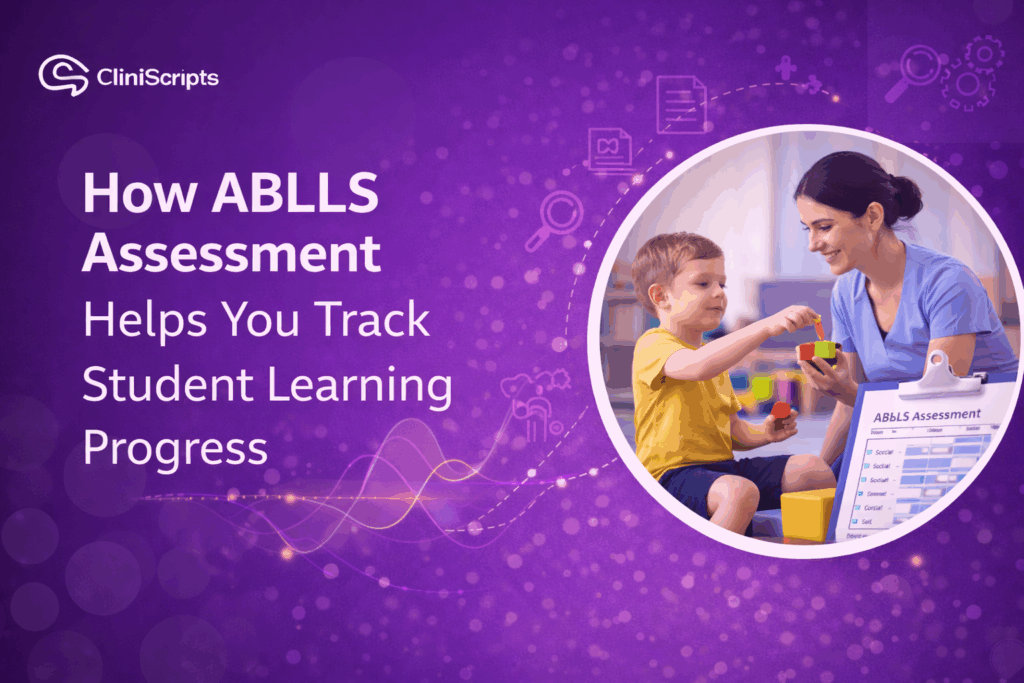
When working with children who have language delays or autism, it’s essential to have a clear understanding of their current level and their progress. That’s where the ABLLS (Assessment of Basic Language and Learning Skills) comes in. This tool helps teachers, therapists, and caregivers understand a child’s learning strengths and needs, guiding them in setting realistic goals for steady growth and development.

What Is the ABLLS Assessment?
The ABLLS assessment is a detailed system designed to measure language, academic, and social skills in children with developmental delays. It covers 26 key areas, from visual performance and reading to communication and self-help.
Each task within these areas is rated based on the child’s ability to perform it, allowing you to identify which skills are strong and which require extra support.
Why We Recommend Using ABLLS
At Cliniscripts, we believe that progress tracking is just as crucial as teaching itself. The ABLLS provides a clear visual representation of your student’s or child’s improvement over time.
Here’s why we find it so valuable:
- Clear skill breakdowns: They show exactly which skills a child has mastered and which still need improvement.
- Goal planning: Helps you decide what to include in your IEP or daily teaching plan.
- Motivation for families: Parents love seeing visual proof of their child’s growth.
- Ease of progress tracking: You can color-code progress updates every few months to easily compare results.

Tips for Making the Most of the ABLLS Assessment
If you’re new to using ABLLS, here are some practical tips that can make the process smoother:
- Keep all needed materials organized in one place for easy access.
- Take short notes or use sticky notes while assessing to capture new goal ideas.
- Update the progress chart twice a year to maintain a clear record of growth.
- Use different colors for each assessment date to make progress visually engaging.
These small steps help you stay consistent and make the ABLLS assessment easier to manage over time.

Who Should Use ABLLS?
This tool works best for:
- Students with emerging language or academic skills
- Children with autism or developmental delays
- Educators and therapists looking for data-driven insights
For older or more independent students, you may choose to combine it with other educational assessments to ensure a balanced understanding of academic and functional abilities.

FAQs
Q1: How often should I update the ABLLS assessment?
You can update it twice a year or before each IEP meeting to track progress effectively.
Q2: Do I need special materials to complete ABLLS?
Not necessarily. You can use everyday classroom materials for most tasks.
Q3: Can parents use ABLLS at home?
Yes, parents can use it with guidance from a teacher or therapist to better understand and support their child’s development.
At Cliniscripts, we value tools like ABLLS that make teaching and therapy more meaningful and measurable. It’s not just an assessment—it’s a window into every child’s growth journey.





 All Rights Reserved